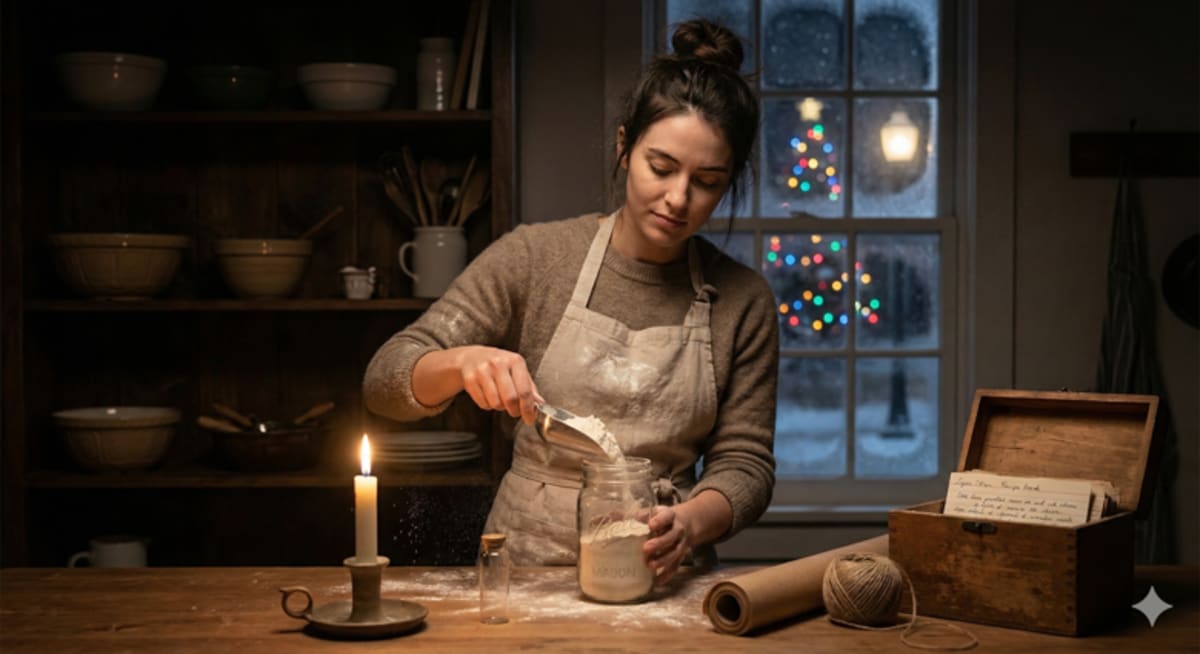
The bakery had been dark for three hours when Tonya finally opened her laptop. She sat at the small wooden table in the back room, the one Mrs. Bellamy used for paperwork and ordering supplies, with a mug of chamomile tea cooling beside her elbow. Outside, snow fell in thick, lazy spirals past the frosted window, each flake catching the yellow glow of the streetlamp on the corner. The rest of Main Street slept, shops shuttered, Christmas lights blinking their patient rhythm into the December night.
Tonya pulled her cardigan tighter around her shoulders and clicked over to Ko-Fi. She'd started the page six months ago, mostly at Kent's insistence.
"People want to support you," he'd said, leaning against the bakery counter with that easy grin of his. "Let them."
She hadn't expected much. A few dollars here and there from regulars who appreciated the cinnamon rolls. Maybe the occasional tip from someone who'd stumbled across her Instagram photos of sourdough loaves cooling on wire racks. But the donations had trickled in. Small ones, mostly. Three dollars. Five. Sometimes ten, with messages that made her chest tighten in ways she couldn't name.
For the bread that saved my morning.
Because your bakery makes Snowhaven feel like home.
Keep doing what you're doing.
Tonight, there was a new notification.
Winterbound donated $5.00
Tonya clicked on the message.
I've been following your Ko-Fi for months now. I'm stationed overseas—can't say where, but it's cold and far from anywhere I've ever called home. I work most nights. The kind where you forget what daylight looks like, or what your mom's kitchen smells like, or what it feels like to bite into something warm that someone made because they cared, not because it came out of a vending machine.
I know it's impossible. I know you can't send bread across oceans. But I saw your sourdough this morning (well, my morning, your yesterday), and I thought: I wish I could taste that. Just once. I wish I could know what it's like to eat something that looks like it has a soul.
Anyway. Thank you for sharing your work. It helps, even from here.
—W.
Tonya read the message three times. Then she set down her mug and pressed both palms against the table. Her heart was doing something complicated in her chest, something that felt like recognition and longing and the particular ache that came from knowing someone was hurting and being too far away to fix it.
She knew that ache. She'd spent fifteen years cataloging it, tracking it, learning to recognize its particular shape in other people's lives. Houses that had gone too quiet. Families holding their breath. The specific quality of silence that meant someone, somewhere, needed finding.
But this was different. Winterbound wasn't in crisis. Not the kind the Midnight Baker visited, anyway. No one was dying. No one was facing eviction or bankruptcy or the kind of grief that hollowed a person out from the inside. Winterbound was lonely. Far from home. Cold in a way that had nothing to do with the weather.
And bread couldn't travel across oceans.
Except.
Tonya's fingers hovered over the keyboard. Except maybe it could. If she was willing to bend the rules she'd been so careful to follow. If she was willing to trust that the magic, whatever it was, wherever it came from, could stretch further than midnight deliveries and anonymous porch drops.
She glanced toward the kitchen, where the ovens sat dark and cool, waiting for tomorrow's 2:45 AM wake-up call. Then she stood up, crossed to the supply closet, and pulled out three small mason jars.
* * *
The Midnight Baker's magic worked in person. That was the rule Tonya had learned from fifteen years of watching. The rule she'd absorbed from her own childhood miracle, from the gingerbread house that had arrived on a frozen Christmas Eve and brought her mother back from the edge of grief. She remembered the way her mother's hands had shaken when she'd lifted the lid of that unmarked box, the way her breath had caught at the sight of the little candied windows glowing amber in the kitchen light. The gingerbread had smelled like cinnamon and cloves and something else, something that didn't have a name but made the whole house feel warmer just by existing.
In person. In crisis. In the dark hours between midnight and dawn. Those were the conditions. Those were the patterns she'd tracked in her notebook, the ones she'd mapped across fifteen years of anonymous deliveries and impossible timing. The Midnight Baker appeared when someone needed finding, and the magic worked because the baker was there, present, close enough to leave a package on a porch and disappear before anyone saw.
But Winterbound wasn't here. Winterbound was thousands of miles away, in a place that couldn't be named, working shifts that swallowed daylight whole. And the crisis wasn't dramatic. It wasn't the kind of emergency that made headlines or brought neighbors to their doors with casseroles and condolences. It was slow and grinding, the kind that wore a person down one cold, lonely shift at a time. The kind that made you forget what your mother's kitchen smelled like, what warmth tasted like, what it meant to eat something made by hands that cared whether you lived or died.
Tonya set the jars on the counter and stared at them. The glass caught the faint glow from the streetlamp outside, three small vessels waiting to be filled with something she wasn't sure she knew how to give. She could do nothing. That was always an option. She could send a kind reply, maybe a digital postcard of Snowhaven in the snow, the kind of gesture that meant well but landed soft and dissolved like sugar in rain. She could follow the rules she'd so carefully documented, the ones that said magic required presence, required proximity, required the baker to be close enough to feel the weight of the need.
Or.
She could trust that kindness didn't need proximity to land. That magic, real magic, the kind that lived in intention and care and the particular way flour felt between your fingers when you were making something for someone who needed it, could travel as far as the person carrying it was willing to send it. She could trust that the distance between Snowhaven and wherever Winterbound was stationed wasn't measured in miles but in the space between wanting to help and deciding to try.
Tonya reached for the flour canister. The metal was cold under her fingers, familiar in the way that only things touched daily for years could be. She lifted the lid and breathed in the dry, clean scent of unbleached wheat, the smell that meant morning was coming, that bread was possible, that someone somewhere would wake up to something fresh and warm because she'd chosen to make it so.
"Okay," she whispered to the dark kitchen. "Let's see if this works."
The words hung in the air, small and certain. Outside, the snow kept falling, covering Main Street in another layer of white. Inside, Tonya pulled the first jar toward her and began to measure.
* * *
Tonya didn't tell anyone. Not her mother, who would have worried about postage costs and the risk of glass jars breaking in transit. Not Mrs. Bellamy, who would have asked too many questions. Not Kent, who would have grinned and said something about Tonya going full Midnight Baker, and she wasn't ready to hear that out loud yet.
This was hers. A small experiment. A single, quiet act of faith.
It took her two nights to get it right.
The first night, she worked in her mother's kitchen after dinner, spreading ingredients across the old oak table while her mom graded library returns in the living room. She started with the Midnight Baker's sourdough starter, the one that had been alive longer than Tonya herself. The starter lived in a ceramic crock on the counter, its surface bubbling with the slow patience of something that had learned to wait.
She measured flour into the first jar. Not bread. Not yet. Just the promise of bread. Flour, starter, salt, and a small cloth bag of sugar, each ingredient layered so the colors showed through the glass like sediment in stone. White and cream and gray-white crystals, a geology of intention waiting to be activated.
She wrote out instructions on an index card in her neatest handwriting.
Add 1 cup warm water.
Stir until smooth.
Let rest 30 minutes.
Knead for 5 minutes.
Let rise 2 hours.
Bake at 375°F for 30 minutes.
Some warmth travels better than others.
No signature. That was important. The Midnight Baker never signed her work.
But it wasn't enough. Tonya held the jar up to the kitchen light and turned it slowly, watching the layers shift against each other. It was practical, sure. Mail-safe. But it didn't carry the weight she needed it to carry. It didn't hold the intention. It was ingredients in a jar, nothing more. Anyone could buy flour at a grocery store. Anyone could mail a care package overseas. This needed to be something else. This needed to be the kind of gift that arrived already warm, already loved, already knowing who it was for.
The second night, she started over.
This time, she worked after her shift at the bakery, staying late after Mrs. Bellamy had gone home. She locked the front door, turned off the lights, and stood in the kitchen with only the glow of the streetlamp coming through the window. The ovens were cool, and the mixers were silent.
Tonya lit a candle. Not for ceremony; she wasn't religious, not in any formal way. But it felt right. The Midnight Baker's deliveries had always carried warmth, and warmth needed fire. The flame cast dancing shadows across the stainless steel counters, turning the industrial kitchen into something older, something that remembered when bread was made by firelight and every loaf was a small miracle against hunger.
She layered the ingredients again, but this time she slowed between each one.
Flour first. She held the measuring cup in both hands and thought about Winterbound's message. The kind of nights where you forget what your mom's kitchen smells like. She poured the flour slowly, watching it settle into soft white drifts at the bottom of the jar, and she let herself remember her own mother's kitchen on the Christmas Eve when the gingerbread house arrived. The way grief had made everything gray and muted until that box appeared on the porch, until the smell of spices filled the house, and her mother had smiled for the first time in weeks.
Salt next. She pinched it between her fingers, felt the crystals' sharpness against her skin, and thought about preservation. About the way salt kept things from spoiling, kept them whole even across distance and time. About the way love could be packed into something small and sent into the world with nothing but hope to carry it forward.
Sugar. A small cloth bag, tied with kitchen twine. Sweetness. The thing that made bread more than fuel. The thing that made it a gift.
And finally, the starter. A small glass vial of the Midnight Baker's sourdough culture, pale and alive, smelling faintly of fermentation and possibility. This was the heart of it. This was the part that couldn't be bought or replicated or faked. It was handed to Tonya when she met the Midnight Baker. When the Midnight Baker trained her one night. Tonya got the recipe and an old wooden spoon.
She sealed each jar, testing the lids twice to make sure they were tight.
Then she sat down at the prep station and wrote three identical notes.
Add 1 cup warm water.
Stir gently.
Let rest overnight.
In the morning, knead for 5 minutes, let rise 2 hours, bake at 375°F for 30 minutes.
This bread has been rising for a long time. Longer than you know.
Some warmth travels better than others.
She tucked one note into each jar, wrapped them in brown paper and kitchen twine, and addressed the first package in careful block letters to the APO address Winterbound had included in their Ko-Fi profile.
At the post office the next morning, the clerk raised an eyebrow.
"Overseas?"
"Overseas," Tonya confirmed.
"Gonna take a while."
"I know."
She paid for the postage, watched the clerk stamp the package and toss it into the bin marked INTERNATIONAL, and walked out into the cold December morning with her hands shoved deep in her pockets and her heart hammering against her ribs.
Faith, she thought, was just another word for waiting without proof.
* * *
A week passed. Then two.
Tonya went about her days the way she always did. Rising at 2:45 AM when the alarm cut through whatever dream she'd been having, stumbling to the bathroom to splash cold water on her face, pulling on the same flour-dusted jeans and thermal shirt she'd worn the day before. The drive to the bakery took seven minutes in the dark, past houses with their porch lights still burning and the gas station where Tommy worked the overnight shift and always waved when her headlights swept across the lot.
She lit the ovens first. That was the ritual, the thing that made the rest of it possible. The click of the pilot, the soft whoosh of flame catching, the slow climb of temperature on the old analog dials Mrs. Bellamy refused to replace. The kitchen warmed around her in increments, chasing the December chill from the corners, and by the time she pulled the sourdough starter from the walk-in, the space felt like something living.
Kneading came next. The dough was cold and resistant at first, fighting her palms, but she knew how to wait it out. Fold, press, turn. Fold, press, turn. Somewhere in that rhythm, the dough stopped fighting and started yielding, becoming supple and elastic under her hands, becoming bread.
She shaped croissants by five-thirty, layering butter between sheets of dough the way the Midnight Baker had taught her. She pulled cinnamon rolls from the oven at six-fifteen, golden and fragrant, the glaze pooling in the spirals like amber caught in tree rings.
The construction crew arrived at six-thirty, stomping snow from their boots and filling the small dining room with the smell of sawdust and cold air. Tonya handed out sourdough loaves wrapped in brown paper and didn't charge Earl for the extra roll he always tried to pay for. The choir ladies came at eight, ordering their usual assortment of pastries and lingering over coffee while they debated hymn selections for the Christmas Eve service. Gary from the hardware store stopped by at nine for his daily baguette and the weather report he could have gotten from his phone, but preferred to get from Mrs. Bellamy.
"Snow through Wednesday," Mrs. Bellamy told him, wiping down the counter with the same rag she'd been using since Tonya was twelve. "Then clear through the weekend. My knee says so."
"Your knee's never wrong," Gary agreed, and tucked the baguette under his arm like a newspaper.
Tonya listened to Mrs. Bellamy's stories about her grandchildren. The twins were learning to ice skate. The oldest had gotten into a fight at school and then apologized without being told to, which Mrs. Bellamy considered a sign of moral fortitude. And the youngest had asked Santa for a puppy, which Mrs. Bellamy considered a sign of impending chaos.
She let Kent steal bites of her lunch and pretended not to notice. He'd perfected the art of the casual reach, the hand that wandered toward her sandwich while he was telling her about the leak in his apartment ceiling or the new true crime podcast he'd discovered. She let him have the pickle spear and the corner of her grilled cheese and didn't say anything, because saying something would mean acknowledging the pattern, and acknowledging the pattern would mean having a conversation she wasn't ready to have.
But part of her was somewhere else. Part of her was crossing an ocean, tucked inside a brown paper package, traveling toward someone she'd never met. She pictured the jar rattling in the belly of a cargo plane, or nestled in a mailbag on a ship cutting through gray water, or sitting in some sorting facility in a country she couldn't name, waiting for the next leg of a journey she couldn't track.
She didn't check her Ko-Fi page. She was afraid to. Afraid there would be nothing, or of something being there. Afraid that whatever she found would prove the whole experiment had been foolish, a woman playing at magic she didn't understand, sending ingredients across the world as if flour and hope could survive customs.
* * *
The notification came on a Thursday night, three weeks after she'd mailed the package.
Tonya was home, curled up on the couch with her cat purring on her lap and a book she wasn't reading open in her hands. She'd been on the same page for twenty minutes, her eyes moving across the words without taking any of them in. Her mother had gone to bed an hour ago, and the house was quiet except for the wind rattling the windows and the soft hum of the refrigerator in the kitchen. The Christmas tree in the corner threw colored light across the ceiling, red and green and gold shifting in slow patterns whenever the heat kicked on and stirred the branches.
Her phone buzzed against the arm of the couch.
Tonya picked it up without thinking, expecting a text from Kent, a weather alert, or another notification from the library app reminding her that her holds were ready. But the screen showed something else.
New Ko-Fi message from Winterbound
Her heart stopped. Then it started again, too fast, hammering in her chest like it was trying to escape. The cat lifted his head and gave her a look of pure feline irritation, disturbed by the sudden tension in her body.
She opened the app with shaking hands.
There was a photo attached.
It showed a pair of hands, small, with short nails and a band-aid wrapped around one thumb, cupped around a white ceramic mug. The mug was filled with something thick and pale, steam rising from the surface in soft spirals that caught the light from somewhere off-frame. In the background, barely visible, a narrow bed with military-issue blankets tucked tight at the corners. A tiny desk with a lamp. A window showing nothing but darkness, the kind of darkness that could have been anywhere in the world, any time zone, any distance from home.
The message beneath the photo was short.
I don't know how you did this. I don't know how something that started as flour and a glass jar turned into this. But I made it tonight after my shift, and it tastes like…
I don't even have words. It tastes like my mom's kitchen. Like the bread my grandmother used to make on Sundays. Like someone, somewhere, remembered I was cold and decided that mattered.
I ate it with butter and honey, and I cried, which probably sounds ridiculous, but I haven't cried in eight months, so maybe it's not ridiculous. Maybe it's just what happens when you remember what home tastes like.
Thank you. I don't know who you are. I don't need to. Just… thank you.
—W.
Tonya read the message four times. The words blurred on the third reading, and she had to blink a few times to bring them back into focus on the fourth. She saved the photo to her phone. Then she set the device face down on the coffee table and sat still in the dark living room with her hands pressed over her mouth.
The Christmas lights blinked their patient rhythm. The wind pushed against the windows. Somewhere in the walls, the old house creaked and settled, the sounds she'd been hearing her whole life, the sounds that meant home.
The cat chirped. A small, questioning sound, the one he made when he wanted attention or food or simply acknowledgment that he existed and mattered.
Tonya laughed. She picked up the cat, all twelve pounds of orange fur and rumbling purr, and buried her face against his neck. He smelled like the lavender sachets her mother kept in the linen closet and the particular dusty warmth of a cat who spent his days sleeping in sunbeams.
She let herself cry. Just the overwhelming fullness of knowing that kindness had landed. That something she'd made with her hands and sent into the dark had found its way home to someone who needed it. That the magic, whatever it was, wherever it came from, could stretch further than she'd ever dared to believe.
The cat tolerated the embrace for approximately thirty seconds before squirming free. He jumped to the floor, gave her a look of dignified reproach, and stalked off toward the kitchen in search of compensation.
Tonya wiped her eyes with the sleeve of her sweater and reached for her phone again. She opened the photo one more time, studying the hands wrapped around that mug, the steam rising, the darkness beyond the window. Somewhere on the other side of the world, someone was warm tonight. Someone had tasted bread that carried intention across an ocean, and it had landed the way it was supposed to land.